Monday, November 7, 2011

DAMAGE FROM OCTOBER 29, 2011 STORM

Metasequoia branch damaged and removed


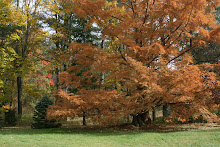
An early heavy snow blew in on Saturday October 29, 2011 and left a lot more damage than one would think to the rare collection of trees and scrubs at Pine Hollow Arboretum. The storm was much lighter in the Albany, NY area than in other parts of the Northeast with millions without power due to fallen limbs and trees in the Middle Atlantic and New England States. Only three to five inches of wet snow fell on lower elevations, such as the Slingerlands, NY area where Pine Hollow Arboretum is located. As with all natural phenomenon the storm damage gave us the opportunity to learn from it as well as to see once again an illustration of Nature's landscape shaping ability. According to John Abbuhl, although there was significant damage to a number of our large trees, there does not seem to be any fatal blows struck. Although now shaped differently and in some cases topped-off, all the trees are expected to sprout new growth and continue to thrive. Because their needles had not yet dropped there was damage to a number of lower and upper branches on our big metasequoia in The Metasequoia Field and 80% of the tallest Fastigate Bald Cypress broke off. The top of a Sweetgum and a Sourwood that was in beautiful fall foliage were damaged. The Sourwood was about 12ft. high and lost one of its two double trunks. In front of the VISITOR CENTER more than 75% of a hybrid Kousa and American Dogwood broke from the weight of the wet snow.


damage on hybrid of Kousa and American dogwood

Something that John Abbuhl noticed is quite interesting and points out again the specialness of the Pine Hollow Arboretum landscape. John said there was almost no damage to pine or fir branches. He said the White Pine had already had its needle drop with approximately 50% of needles being shed. Blackgum leaves had dropped and that species had almost no damage from the storm. The oak trees are strong and could take the snow weight without breaking branches.
In fact, there was almost no limb loss on native trees. I take that to show the adaptation of the native species had allowed them to better deal with unexpected but not unknown variation in the usual weather patterns. Although we are impressed with the uniqueness and marvel that species from all over the world can survive at Pine Hollow Arboretum. It is also important to recognize these "special visitors" might need special care to keep them healthy and growing.

---Alan Casline

Tuesday, October 18, 2011

"Fruits of the Fall" Arboretum Tours


"Fruits of the Fall"

Pine Hollow Arboretum Tours will be presented
on the afternoons of Sat Oct 22, Sunday Oct 23, and Sat, Oct 29, 2011

Start time for all of the tours would be 1:00 pm.

MEET AT THE VISTORS CENTER
FOR START OF ALL EVENTS

Pine Hollow Arboretum Visitor Center
16 Maple Avenue
Slingerlands, New York 12159
The tours will all be led by arboretum founder and developer Dr. John Abbuhl

John says the following." hard to be specific, but it will include Pawpaw, Persimmon, Apple, Quince, winter berry holly, and whatever else is in bloom... (magnolia seeds are worth looking at as well)"

Please call ahead if you can to reserve a place (518) 439-6472

Thought is the blossom, language the bud, action the fruit behind.

- Ralph Waldo Emerson

Thursday, October 6, 2011

Fall Festival Open House

THE PINE HOLLOW ARBORETUM


FALL FESTIVAL OPEN HOUSE


SUNDAY, OCT 16th

1-4 PM at 16 Maple Ave

VISITORS CENTER

WE INVITE THE COMMUNITY TO
SHARE THE COLOR AND
BEAUTY OF THE SEASON


AS WE EXTEND A
THANK YOU
TO ARTISTS OF THE CURRENT SHOW
AND
TO MEMBERS FOR THEIR SUPPORT

WITH AN OPEN HOUSE
WITH REFRESHMENTS

ACTIVITES WILL INCLUDE
A SCAVANGER HUNT AND A
TOUR WITH DR. ABBUHL

(weather permitting)

Monday, October 3, 2011

PAWPAW TREES AT PINE HOLLOW ARBORETUM

Pawpaw Tree Asimina triloba at Pine Hollow Arboretum

Remember when you were a kid in school and were taught the PawPaw Patch Song? You know, “Where, oh where, oh where is Susie? Where, oh where, oh where is Susie? Way down yonder in the pawpaw patch… Pickin’ up pawpaws, put ‘em in a basket… way down yonder in the pawpaw patch.” I know I’m dating myself because my daughter (8th grade) and son (2nd grade) have never heard of the song but I learned it -- way back when. I remember singing the song in grade school but I had no idea what a pawpaw was and didn’t know what one was until today. I was visiting the Arboretum and talking with my father-in-law, John Abbuhl, about fall fruiting trees on the property. He said he has a few and asked me if I had ever seen a pawpaw tree and since I had not, he said “come with me.” We walked down the trail by the pond, over the bridge and there they were. Beginning of Pawpaw grove at Pine Hollow Arboretum

Pawpaw or Asimina Triloba is a deciduous, conical tree grows between 12 to 20 feet. It was first discovered in 1541 by the Spanish explorer, Hernando Desoto on an excursion to the Mississippi Valley but has long been recognized as a source of food by indigenous Americans for centuries before that. Apparently, Lewis and Clark ate them during their epic journey across North America. They are often referred to as Poor Man’s Banana. The tree produces root suckers a few feet from the trunk and when allowed to grow can create a new tree which is why the Arboretum now has a cluster of pawpaws which are located at the eastern end of the magnolia grove near the mid-pond hill. The tree has droopy, oblong shaped green leaves that grow up to 12 inches long. The leaf color is medium green in the summer and turns yellow in the fall. The leaves begin to fall off in mid-autumn and leaf out again in late spring. The pawpaw produces an upside-down maroon flower up to 2 inches across usually during March to May depending on the climate where it’s growing. The pawpaw tree likes filtered sunlight for the first two years after planting then full sun. The deer do not seem to like the leaves or twigs but raccoons, squirrels and foxes will eat the fruit.Pawpaw leaves turning yellow in Autumn

The pawpaw fruit is the largest edible fruit native to America. Each fruit can weigh between 5 to 16 ounces and can be 3 to 6 inches long. They are similar in shape to a potato and can grow in clusters from one to nine fruits. The skin of the pawpaw is thin and edible but people usually peel it off prior to eating. The skin color is green and turns yellow when it is ripe in September - October. When you touch a ripe pawpaw fruit it should be soft to the squeeze. You may think it’s a sign of it being overripe but it’s not. If the skin is brown or black it is overripe. When you cut into a pawpaw you will see two rows of brown/black seeds shaped like lima beans. The color of the pulp can vary from white to orange. The texture of the pulp is soft and creamy much like the consistency of custard. The taste is often compared to bananas with hints of mango and pineapple. Early settlers made jelly with pawpaw and you can also use it in bread, pie or ice cream. If you’re curious about what a pawpaw looks like on the tree, please stop by the Arboretum for a peak at what nature has to offer.

Pawpaw fruit at Pine Hollow Arboretun


----Susan Abbuhl

Friday, September 23, 2011

INDIAN SUMMER SEPTEMBER 21, 2011: A PHOTO VIEW

                                                     color photo   nature does it again, beautiful

Walked the grounds at the arboretum on a sunny late afternoon. I was struck how it is a time of seeds, nuts and fruit. I ran into John Abbuhl planting trees. He took the time to show me the Pawpaw and Persimmons fruits and even the magnolia fruits. (I didn't even know such existed). He had to go back to planting and I continued my enjoyable walk. I had my hiking boots on and I really don't care if I get my feet wet. I noticed the downhill water runoff. As visitors know there are more than ten small ponds at the arboretum, what is less noticeable is the ditching and connecting waterways that help to keep the land underfoot solid and drained relatively quickly.
Here are some photos of my hike. Give yourself a nice walk and stop by the arboretum next time the sun shines.

"Keep a green tree in your heart and perhaps a singing bird will come."- Chinese proverb
persimmon fruit

I like trees because they seem more resigned to the way they have to live than other things do.
- Willa Cather (1873-1947), O Pioneers 1913

magnolia fruit

pawpaw fruit

"Do not be afraid to go out on a limb ... That's where the fruit is."- Anonymous

"Sometimes Thou may'st walk in Groves, which being full of Majestie will much advance the Soul."
- Thomas Vaughan, Anima Magica Abscondita


----- Alan Casline

Wednesday, September 21, 2011

PINE HOLLOW ARBORETUM RECEIVES NEW FUNDING

Pine Hollow Arboretum is pleased to announce the receipt of two grants, totaling $13,300, from the Bender Family Fund and the Bender Scientific Fund, both of which are managed by the Community Foundation For The Capital Region.

Both the Bender grants will support the arboretum's core mission, which is:

1) to deliver innovative educational programming for adults and students of all ages, in the Town of Bethlehem as well as the greater Capital Region and beyond; and

2) to carry out field based science research, primarily with students, that documents and tracks specific features of the arboretum, both large and small - ranging from individual tree specimens, to soil and pond PH, to ever changing animal, plant and insect life.

"We want to thank the Community Foundation, and especially the Bender Family, for generously providing Pine Hollow our first two grants," says Dr. John Abbuhl, Founder and President of the Pine Hollow Arboretum Board. "Our Board of Directors has worked very hard in the first few years of our organization's existence to lay a strong community based presence from which we can now, thanks to this funding, begin to develop and deliver a wide range of educational programs that revolve around the beauty and majesty of our trees."
The Bender Family released this statement:

“The Trustees are delighted to help “jumpstart” the Community Education Resource Center at the Pine Hill Arboretum. “The important collaboration with Bethlehem Central School District’s Science Education Program will bring hands-on learning to many students across the Capital District in a unique “community” classroom.”

Finally, PHA Board Member, and Bethlehem Central Middle School Principal, Mike Klugman is the Principal Investigator for the Bender Scientific grant:

“PHA provides the Bethlehem community with an invaluable educational and ecological resource and the aim and endeavor of this grant is to enlighten our community on both fronts.

Thursday, September 8, 2011

ART SHOW AND SALE OPENS SEPT 17+18

Opening of an Art Show and Sale on Sept 17 + Sept 18 at the Arboretum. This is an amazing exhibit by 25 Local artists who are sharing their interpretation of nature using the Arboretum and elsewhere. The enthusiasm of the artists as they have created their images is contagious! There were no rules,no judges, just for fun! We are so lucky to be able show you such talent! The exhibit will be open every weekend at the Visitors Center (hours 10 AM to 4 PM )for you to enjoy until Oct. 16th. Come see the art, enjoy light refreshments, and if the weather improves enjoy the Arboretum itself with a tour by Dr. Abbuhl on Sat Sept 17 at 1PM We will be happy to welcome people at other times by appointment. call 439-6472