I remember my first visit, as a 9 year old more than 30 years ago, to the American Museum of Natural History (AMNH) like it was yesterday. I desperately wanted to be an archeologist and search for dinosaurs around the planet and visiting the Museum was like going to a candy store. For every fossilized dinosaur I saw that day I imagined two more that I could have discovered. I imagined going back in time to what the Earth could have been like during the time of the dinosaurs and in my mind’s eye I could stand and watch an amazing clash of these titans.
I also have another very distinct memory of that day. It was the day that I first became awed by any member of the plant world, and more specifically, the day that I began to love trees.
If you haven’t visited the museum and you love trees, or if you just have a general neutrality about trees you will want to visit the display of a cross-section of a Giant Sequoia tree cut down in 1891 that lived to be more than 1,300 years old. This specimen, that once stood more than 300 feet tall, inspired words like “proud,” and “majestic,” but it also inspired an overwhelming sense of humility. This specimen reminded me of what a big, beautiful, and wondrous planet we live on and it led me to perspective on the significance of a species that lives for 10 to 20 times or more than that of man. Humility wasn’t a word that I was familiar with then, but on that day I discovered what it meant. (see:
http://www.amnh.org/exhibitions/expeditions/treasure_fossil/Treasures/Giant_Sequoia/sequoia.html)
I also remember being saddened by the demise of this tree, but even more I remember being elated that there were several

more specimens still alive that were older and taller. I have not yet visited California to see these amazing wonders, but it is on the top of my list of places to go and soon.
As I stared in awed reverence at the display I quickly realized the impossibility of trying to count the rings of this tree. Fortunately, the museum marked significant dates in human history with their corresponding chronologic ring along the cross sectional girth. To think that this tree stood serenely on the western coast of this “new” land when Christopher Columbus set foot for the first time on its soil is fascinating and even at this point in time, this tree was nearly 1,000 years old.
I was deeply moved for reasons that I couldn’t understand (after all, I was only 9). I tried to imagine what it must be like to be an organism that witnessed 1,300 years of history. How many snow storms, lightning strikes, new and extinct species of animal and plant, and human events had this organism been present to observe? Even at 9 I had a concept of trees not being sentient in the sense of being able to make observations, but knowing and imagining are two different things. In my imagination, this tree was like a wise elder friend silently, but positively ‘there’ whenever one would want to, or need to visit. I imagined myself lying by myself in a forest of these quiet giants simply staring at their majesty and the sky through their branches. It’s hard to imagine what stress feels in this context. One simply goes to a place where stressors just don’t seem important.
After a few minutes I came to realize the conspicuous quiet of the display despite the ten or so other visitors who, like me, were simply in awe. I was comforted in knowing that I was not alone in this quiet celebration of a species that wasn’t ‘us.’
Today, some 32 or so years later, I still love trees. Among some of my favorites are many trees who I would guess remain largely inconspicuous to most. The love that I have for trees has an additional dimension now though. As much as I still find peace and calm when I walk among trees, I also revere trees for the interdependence that we humans have with them.
INTERNATIONAL EFFORTS
As I write this, leaders from around the world (119 countries to be precise) have gathered in Copenhagen for the United Nations Climate Change Conference (
http://en.cop15.dk/) and all hopes from around the world point to interventions that will have a dynamic impact on our entire planet.
Among these is the preservation of trees. The photo to the right demonstrates deforestation in Brazil. This entire region was once covered with rainforest, but as a result of the

different
governmental policies and lack of protections it is now all too evident where deforestation exists. Let this picture serve as an indication of what irresponsible actions look like. Let this picture also serve as cause for hope that we all can recognize how responsible action can inform policy and cause positive change that reaches far into the future.
Closer to Home
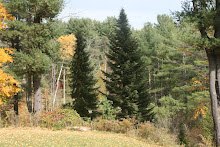
For lovers of trees who would like to celebrate and enjoy a prime example of how we can live responsibly and celebrate our interdependence with trees I would encourage a visit to the Pine Hollow Arboretum. With nearly 3,000 plantings of trees and shrubs that are zoned for this region the Arboretum is a place that I find inspirational. Dr. John Abbuhl’s effort to cultivate the Arboretum enters its 45th year and if one isn’t inspired by the level of detail of the site, s/he will be after talking with John about any of the species planted here.
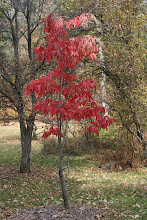
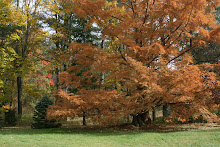
Among my favorites are the Metasequoia, cousin to the Giant Sequoia. John has several planted that, although nearly 30 years old and almost 75 feet tall, are in their infancy! One can’t help but wonder what historical events these great trees will witness. Oh, and they aren’t even the tallest trees in the Arboretum…yet!
For readers who would like more information on subjects like this one please read the words of E.O. Wilson (
http://www.eowilson.org/ ), and Wangari Maathai (
http://en.cop15.dk/blogs/view+blog?blogid=1893).
Michael Klugman
K-12 Science Supervisor
Bethlehem Central School District
Photos in the left hand column can be enlarged by clicking on the photo. Photo credits for this post (from top of column) Metasequoia at Pine Hollow, Giant Sequoia from http://fs.fed.us/r5/sequoia/gsnm/feis/chap1/images/ and http://goes.gsfc.nasa.gov/pub/goes/010808.brazel.gif/