Showing posts with label PIne Hollow Arboretum. Show all posts

Monday, March 17, 2014

2014 VOLUNTEER MEETING AT PINE HOLLOW ARBORETUM

Dear Members and Friends of the Arboretum:

Spring is on its way and we need your help!


To help launch Pine Hollow Arboretum’s 2014 season, we are inviting you to an informational volunteer meeting on Thursday, March 27 at 10:00 a.m.  If you are interested in lending a hand and want to learn more about how you can help make a difference please join us.  

Some of our needs include:
  • Help with gardening under the direction of our property manager
  • Be a greeter at the Visitor Center on weekends (flexible hours)
  • Help with our Spring/Fall Open Houses and various workshops
  •  Assist with fundraising and promotional activities
Our active season runs from April through October.  If you are interested in joining a great group of energetic and nature loving people please join us and bring a friend!  The meeting will be held at the Visitor Center, 16 Maple Avenue, Slingerlands.  

For planning purposes, if you would like to attend, please respond to this email at: 

pinehollowarb@aol.com 

If you are unable to make it but would still like to help please respond anyway and we will personally get back in touch with you.   


Thank you!


Saturday, June 23, 2012

Subject: Gary Lawless: 2 Poems Live @ Pine Hollow Arboretum 15-June-2012

Subject: Gary Lawless: 2 Poems Live @ Pine Hollow Arboretum 15-June-2012.
This video is now live. What a great time!
One of my favorite poets in a great space to read!

Check out this video on YouTube:


Gary Lawless: 2 Poems Live @ Pine Hollow Arboretum 15-June-2012


http://www.youtube.com/watch?v=IQ-qBzaIRAI&feature=youtube_gdata_player

from  obeeduid~

Monday, January 30, 2012

American Holly at Pine Hollow Arboretum

Green Leaf and Red Berry on a December Day at Pine Hollow

Welcome Winter! Tis the most wonderful time of the year! Seems strange though that we have not seen much snow whirling about but soon enough I’m sure. I love winter at the arboretum. Something about the way the bare branched trees create a level of transparency throughout the woods. It makes the pines and the ponds seem to standout even more. The birds are especially noticeable and fun to watch; the way they dart about yet seem to hang around curious about these strange two legged creatures in their space.


One of my favorite winter berry trees at the arboretum is the American Holly Tree or Ilex opaca. There is a big male one that can be found at the beginning of the Fir Trail and then a couple female ones with red berries in the vicinity. As you probably know, the holly tree is a popular ornamental tree during the winter holiday season because of its attractive red fruit and dark green leaves. It can grow to be 15 to 30 feet tall. It has a smooth gray-brown bark and a dense crown. The evergreen leaves are lined with sharp spiny edges. The tree produces a greenish-white flower

Light green trees in background of photo are American Holly

from April thru June which is replaced by red berry-like clusters in the fall. The tree is native to the eastern and gulf regions of the U.S. The holly tree prefers moist soils such as on the borders of swamps but on the other hand thrives on drier soils in protected areas such as along the coast behind sand dunes. It is slow growing and is not reliably cold hardy throughout New York State which makes the arboretum’s specimen so special. The evergreen leaves and berries provide shelter and nourishment to birds of all kinds.
One additional piece of information that I found while doing research on this tree was that the Holly tree has a significant place in history. A study of all colonial gardens of Virginia shows that Holly trees were a favorite of them. Also, there are a number of entries in George Washington’s diary referencing Christmas Holly. In one instance he recorded that he transplanted many little Hollies from the woods but then confessed that his transplanting experiment failed and they died. He apparently tried again because today thirteen of the Hollies that Washington planted still stand. Amazing!
Enjoy the cold winter season!


Post Written by Sue Abbuhl
Photos December 2011 at Pine Hollow by Alan Casline

Tuesday, October 18, 2011

"Fruits of the Fall" Arboretum Tours


"Fruits of the Fall"

Pine Hollow Arboretum Tours will be presented
on the afternoons of Sat Oct 22, Sunday Oct 23, and Sat, Oct 29, 2011

Start time for all of the tours would be 1:00 pm.

MEET AT THE VISTORS CENTER
FOR START OF ALL EVENTS

Pine Hollow Arboretum Visitor Center
16 Maple Avenue
Slingerlands, New York 12159
The tours will all be led by arboretum founder and developer Dr. John Abbuhl

John says the following." hard to be specific, but it will include Pawpaw, Persimmon, Apple, Quince, winter berry holly, and whatever else is in bloom... (magnolia seeds are worth looking at as well)"

Please call ahead if you can to reserve a place (518) 439-6472

Thought is the blossom, language the bud, action the fruit behind.

- Ralph Waldo Emerson

Wednesday, September 21, 2011

PINE HOLLOW ARBORETUM RECEIVES NEW FUNDING

Pine Hollow Arboretum is pleased to announce the receipt of two grants, totaling $13,300, from the Bender Family Fund and the Bender Scientific Fund, both of which are managed by the Community Foundation For The Capital Region.

Both the Bender grants will support the arboretum's core mission, which is:

1) to deliver innovative educational programming for adults and students of all ages, in the Town of Bethlehem as well as the greater Capital Region and beyond; and

2) to carry out field based science research, primarily with students, that documents and tracks specific features of the arboretum, both large and small - ranging from individual tree specimens, to soil and pond PH, to ever changing animal, plant and insect life.

"We want to thank the Community Foundation, and especially the Bender Family, for generously providing Pine Hollow our first two grants," says Dr. John Abbuhl, Founder and President of the Pine Hollow Arboretum Board. "Our Board of Directors has worked very hard in the first few years of our organization's existence to lay a strong community based presence from which we can now, thanks to this funding, begin to develop and deliver a wide range of educational programs that revolve around the beauty and majesty of our trees."
The Bender Family released this statement:

“The Trustees are delighted to help “jumpstart” the Community Education Resource Center at the Pine Hill Arboretum. “The important collaboration with Bethlehem Central School District’s Science Education Program will bring hands-on learning to many students across the Capital District in a unique “community” classroom.”

Finally, PHA Board Member, and Bethlehem Central Middle School Principal, Mike Klugman is the Principal Investigator for the Bender Scientific grant:

“PHA provides the Bethlehem community with an invaluable educational and ecological resource and the aim and endeavor of this grant is to enlighten our community on both fronts.

Monday, June 20, 2011

GRAND FIR AND NOBLE FIR

Walking down the Enterance Trail into Pine Hollow Arboretum the shapes of green pines and fir trees open up like gateways to the rich vistas and arranged plantings. As you learn more about the trees on display, the interesting sights take on a more informed aspect. An example are the two matched fir trees growing closely together where the downslope flattens out at the end of the hill Enterance Trail. They are the Grand Fir (Abies grandis) to the left and growing within the Grand Fir's spreading branches, a different fir trunk, the Noble Fir (Abies procera). Arboretum founder and planter John Abbuhl allows that the two trees could of been placed with more distance between them but as they stand they illustrate the famous Aesop fable "The Tortoise and the Hare". Both Firs were planted at the same time. The largest of all firs, the Grand Fir can grow 300 ft. tall. It is a very quick grower and at the Arboretum it dwarfs its fir partner. The Grand Fir is not long lived according to John, with a life span of about 250 years. Next to it, the Noble Fir grows second largest of any fir and lives to a thousand years. The Noble Fir will be standing tall and growing for many hundred years while the Grand Fir next to it will be fallen, decayed and returned to the earth.


Tuesday, April 26, 2011

SPRING APRIL 26, 2011

The Delmar Writers Group Reading is at 7:00 pm on Friday April 29, 2011
Grounds Open All Day. Visitors Center open staring at 5:30 pm.

OPEN HOUSE on Sunday May 1, 2001 starting at 2:00 pm. Arboretum Tour led by John Abbuhl Meet at Visitors Center


Photos taken on Tuesday April 26, 2011 by Alan Casline


Sunday, March 20, 2011

2011 SPRING EVENTS AT PINE HOLLOW ARBOURETUM


The weekend of Friday April 29th to Sunday May 1st are is going to be busy at Pine Hollow Arboretum. On Friday evening the Delmar Writers Group will presenting a Delmar Writers Showcase starting at 7:00 PM at the Visitors Center. Sunday Afternoon May 1st will be the Neighborhood and Community OPEN HOUSE.


Hello Neighbors!
We are the Pine Hollow Arboretum
and we would love to show you around!

OPEN HOUSE

SUNDAY, MAY 1st, 2011
from 2 to 5 pm

at the Pine Hollow Arboretum
16 Maple Avenue
Slingerlands, New York 12195
(518) 439-6472

Pine Hollow Arboretum * a new not-for-profit * 25 acres of trees in a natural setting * within walking distance *


Bring your walking shoes or boots to hike the many trails and to see the property’s varied land and plantings. We go forth rain or shine! Interpreters will be available at unique places.

Light Refreshments will be offered!


No reservation needed but if you know you are coming
please e-mail us at pinehollowarb@aol.com and let us know.

Can’t make it. Send us your e-mail address if you want to stay
informed about opportunities and events

Tuesday, November 16, 2010

BALD CYPRESS


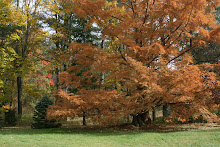
An example of the unique landscape at Pine Hollow Arboretum occurs late in the year when the view is filled with orange, rust and different brown colored trees as well as the different evergreens and yellow, brown and red deciduous hardwoods. One of the "rust" colors comes from the dozen or so Bald Cypress trees found in the Arboretum. The Bald Cypress or Swamp Cypress is a native American tree found in much of the southeastern United States from Maryland to Texas, especially inland up the Mississippi River to southern Indiana. It is common in the Everglades and is the official state tree of Louisiana. It is deciduous in the north and evergreen in the south. It has alternate, awl-shaped leaves, globose cones and sometimes aerial root knees.

The knees or upbent roots project from the root system upward above water level to facilitate gas exchange.Large trees reach 100-150 ft. tall with over 36 ft. trunk diameter. The Methuselah Cypress found in Big Tree Park in Longwood, Florida is 118 ft. tall and 3,500 years-old.

John Abbuhl points out they are a tree that will grow in standing water but they do not have to and will grow equally well in moist soil. John has found Bald Cypress can grow in the north provided the individual tree has the "right genetics". He doesn't think they have great variation in genetic make-up, as for example an apple tree has,but he has observed vast difference in growth pattern from individual tree to tree here in the Arborteum. He reported that there has been a 90% survival rate of Bald Cypress he has planted here. There is one area, however where it is different and 90% have not survived. He has observed it is where reed canary grass predominates. Bald Cypress are called "bald" because of their deciduous character. It is a member of the redwood family of trees. The true cypress belong to a separate family of trees. Like another decidous conifer found at Pine Hollow, the Metasequoia or "dawn redwood", the Bald Cypress dates from very ancient times. During the Jurasic Age it was a widely distributed tree. Two relatives of the Bald Cypress, the Weeping Bald Cypress and the Fastigate Bald Cypress are also present at Pine Hollow Arbouretum. The wood of the Bald Cypress was used by Seminoles for building their houses, canoes and for special ceremonial objects. The Choctaw Indians used the bark for string and rope. Making the wood useful is the fact it is extremely rot and termite resistant. In its native habitate it has been much used for roof shingles and traditionaly has a special use for greenhouse racks and benches. There is a current environmental concern over the use of cypress mulch as opposed to using cedar mulch. Damage to the ecosystem is being caused by the ravaging of cypress swamps in the south for mulch production. Cedar mulch seems more renewable and a more green choice

Thursday, October 21, 2010

BETHLEHEM SCIENCE TEACHERS VISIT


On October 12th Board Member and Bethlehem School District Science Education Coordinator Mike Klugman hosted a gathering of BCHS middle and high school teachers at the arboretum. About 20 "GREEN TEAM" people were in attendance. As a result of the visit Mike and Pine Hollow have received numerous emails from teachers, and others, suggesting ways the Arboretum and its facilities might be used to engage and educate students at all grade levels. While the Life Sciences might be the most obvious area to design and deliver curriculum material there are obvious connections to art, language and even various forms of media studies. Pine Hollow would also like to develop an easy to use curriculum that can be used by a lay person to lead a tour of the arboretum with children. Mike has already brought a few students to do geomapping at the arboretum and plans on expanding efforts in this area. We encourage any interested educators in the area, at any level of study, to take advantage of our unique forest resource. Please phone or email us! Phone:518-439-6472 and E-mail: pinehollowarb@aol.com

Friday, August 27, 2010

WALT FRANKLIN at Pine Hollow Arboretum


WALT FRANKLIN at Pine Hollow Arboretum
Saturday September 25, 2010 at 7:00 pm
Pine Hollow Headquarters Building
16 Maple Avenue Slingerlands NY

At 7 pm Pine Hollow Arboretum
Presents Author Walt Franklin
Reading and Book Signing
for his new outdoor/nature book
Sand & Sage The Trails Beyond
at the Arboretum Headquarters Building


Walt Franklin is a writer, educator, and naturalist since his days of boyhood in the Hudson Valley. An active member of the Genesee Watershed Association in Pennsylvania and of Trout Unlimited in New York. Franklin has also traveled widely throughout Europe and the American West. His many published books include River’s Edge(2008) and A Rivertop Journal (2005). His poetry has been published in a number of books and many magazines including Rootdrinker. He is an appreciator of Bozenkill poet W.W. Christman, whose work he cites as an important influence on his life.

At 4:30 pm Arboretum founder and planter John Abbuhl will lead a Tour of the Arboretum. Please arrive at the 16 Maple Ave. Building by 4:15 as Tour must start on time in order to have enough daylight to be completed.
Preregistration for the tour is not necessary
but is appreciated. Call (518) 439-6472 to sign-up.

For Information on the Reading or Tour phone (518) 439-6472

Friday, February 19, 2010

WINTER WORK AT PINE HOLLOW ARBORETUM


The cold wind may blow but there is still lots of work going on at Pine Hollow Arboretum.
Breaking it down, here are three areas where John Abbul and other Arboretum workers tackle some of the necessary winter tasks. On a seasonal basis, just as nature has cycles and changes, so does the work effort needed to keep the Arboretum
healthy and growing.

First off, John and Steve Truss have been busy with landscape logging. John told me they had just taken down nine trees. Eight ash and one hybrid chestnut. Some trees need to be cut to facilitate the growth of existing plantings. After they fall each tree is cut into small log lengths which are then neatly stacked off the trail. The Pine Hollow philosophy is to leave tree debris to decay in its natural environment. The hybrid chestnut was one of a number in a grove. It did not have the growth characterists of the others and John said thus it was "removed from the gene pool."


Second, John Abbuhl and Audrey Hawkins have been at work on an important labeling project. For six years (2004-2009) plantings had not been labeled. Of the three thousand recorded plantings in Pine Hollow Arboretum approximately 80% have labels. These plantings would be included in the unlabeled 20 %. After their efforts now all the plantings for the six years were entered into the permanent records. These records include the location. From this data it will be possible to place labels on trees. John says "This will be ten times more difficult than you believe." But what a wonderful learning opportunity! This Spring and Summer the labeling project will be advanced by finding the match between planting and planting record and attaching a label to the plant itself.

A third area of winter work is determining the spring order of new specimens. Our world class collection is a mix of the common and the unusual. John Abbuhl said the 2010 order will follow
his traditional method. John said he looks for and will try any new species that can survive in our climate. As the current collection indicates, any fir, spruce, pine, birch or decidious tree that would have a chance of surviving and is not currently growing here will likely be purchased. John will try again with species that have failed in the past and sometimes a past failure will be reversed by changes in the growth variables (such as where on the property it is planted) and/or the genetic characteristics of the specimen itself. According to John three-quarters of Zone 6 rated planting can and have survived here. In dollar terms, Pine Hollow Arboretum is spending more than $2,000 on new plantings this year.


old playhouse

Monday, December 7, 2009

FIRST SNOW AT PINE HOLLOW

View at Maple Avenue Trail
Tao of Pine Hollow (see the ying and yang symbol in this photo?)

"All Dressed Up With No Place To Go"

Cherry Tree on Japanese Hill


Snow Top Hats On Seedheads


Translucent Snow Branch

The first snow, a moist enmeshing cover, came to Pine Hollow on December 5th. These photos were taken on December 6, 2009 around 10 am to 10:30 am Sunday morning. (all photos in lefthand column can be enlarged by clicking on them)


Thursday, December 3, 2009

A FOREST OF EASTERN WHITE PINE AT PINE HOLLOW

Eastern White Pine (Pinus strobus) an evergreen of straight-grained soft wood with little resin. The tree is most prominent on our arboretum landscape. They can live upwards of 450 years but none of our specimens approach that age. Unlike so many imported species we have here, the Eastern White Pines are native, what I call volunteers, and the north section of the arboretum is a natural forest area of approximately five acres with numerous 90-100 year-old trees forming an impressive overstory. Underneath is found a forest floor environment which suits many other native plants, scrubs and second growth trees. Contrast the neat even rows of a pine tree plantation with the multi-trunked organic forms of the pines of our Natural Forest Area. Common names for these trees are northern white pine, soft pine and Weymouth pine. They range through-out eastern North America from Ontario, around the whole Great Lakes and down the Appalachian mountain range to northern Georgia. A variety grows in the mountains of southern Mexico and Guatemala. White pine is now naturalizing along the mountain slopes of the Czech Republic and southern Poland.

The Weymouth pine name for our native (I better say American) tree is an interesting story. The large straight trees that greeted the European settlers were considered "vital" military and commerical resources to the English Government. They were used as masts and keel of sailing ships. In 1620, Captain Weymouth planted the white pine species in England without success. The white pine blister rust disease did not allow their usable growth. England by necessity remained dependent on our native trees. Forests of white pines were declared to be "Kingtrees" and even individual trees were selected with the "broad arrow" axe mark reserving them for the British Royal Navy. This reserving of the best trees fed into the growing resentment of American settlers of their Colonial status. The first flag of the American Revolutionary War had a white pine emblem. During the actual war period the patriots use to challenge each other to see how many Kingtrees a single man could axe and haul.

The white pine has an older sacred history as the Great Tree of Peace for the Haudenosaunne. These native peoples include those who lived in the region where Pine Hollow Arboretum now exists. Legend has it that the Haudenosaunne were living in a dark violent period with war among their five nations. A messager of peace was sent by the creator to bring a way for people to find a Great Law of Peace. The Eastern White Pine became known as The Great Tree of Peace. It was a symbol because being very tall it could be seen from afar. Needles were in clusters of five like the five nations bound together as one. The needles stayed green. Even as seasons change the tree stays green and so shall the Great Peace stay. The white pine was uprooted and into the hole made by the roots were cast down weapons. Buried were greed, hate and jealousy. The tree was placed up again and as tree roots spread in all four directions so was the Great Law of Peace to be spread. On top of the tree sits an eagle. The eagle a watcher to warn of any approaching danger.

I thought the white pine forest here might have been a product of the wave of Conservation Corps seedling tree plantings which were prevalent in New York State in the 1920s-1940s. Not so, according to John Abbuhl. He told me they are first growth, natural seeded in abandoned farm fields. There are a few white pines found in different border areas of the arboretum that are a bit older, from 100 to 120 years old. White pine are scattered through-out the arboretum and observation shows mixed results based on how wet one finds the soil. When the soil is too wet the white pine grow stunted, size limited. Intermediate wet soil allows large tree growth however these trees get wind thrown in spring. A whole tree will be blown down. You see them lying sideways with the whole root section lifted up and away from the land. The hills and drained land are suited to long term growth. John Abbuhl envisions the day when Pine Hollow Arboretum is known as home to a Virgin Forest of White Pine. In talking with John I was surprised to learn a Virgin Forest is defined as one of trees at least 200 years-old. I thought Virgin meant before the coming of the Norman and his sawmill to Albany County and the cutting down of all the big trees to built ships and houses. So John is right, someday there will be a white pine forest here of 200 year-old trees. A baby born this year might see it. Pines grow in open fields, fire areas and where there are landslides and blowdowns. In a deep forest cover there is not enough light for pine seedlings. A White Pine forest is not a climax forest. In tree succession oaks come in under it and in northern environs maples. yellow birch and ash. In the Albany Pine Bush pitchpine is climax because of fire. So imagine you could have a 200 year-old forest of white pine tress that is not a climax forest, that is not permanent, that is going to be replaced.

---Alan Casline


Tuesday, October 27, 2009

METASEQUOIA LIVE HERE


In 1941 Gan Duo, a botanist, came upon a village in west-central China. The villagers there had a small shrine at the base of a large tree of a then unknown species. The villagers worshiped a god they believed lived inside the tree. So was found the first and at the time only live example of a tree known then through its fossil record, the metasequoia (metasequoia glyptoboides) Seeds were collected on later expeditions and a large grove discovered deep in an isolated valley. The native trees are rare. Only a small population was ever known. Found on the Sichuan-Hubei border country, the center of population for the metasequoia was about 6,000 large trees and most of them were logged in the early 1950s. According to The Gymnosperm Database the conservation status of native metasequoia is critically endangered. The tree is known as a fossil or relic tree. One that had world wide distribution 100 million years ago. A common name for it is "Dinosaur Tree" It is thought that the third ice age, 3 million years ago almost drove the tree to extinction. Today the metasequoia is widely planted as an ornamental, especially prized because of its "rapid growth". It is reported that several million trees (most from root cuttings) are planted in China each year. The tree has been introduced in over fifty countries. Other common names for the metasequoia are "Dawn Redwood" and "Water Fir" (SHUI SHANC in Chinese).


John with 2009 metasequoia planting (rust colored)

Experts describe a tree with "a tapering trunk broadening to the buttressed base, conical when young, developing a broad, rounded crown with age." How old the trees live to is not known. The age of over 400 years is attributed to the old tree first found in the village in China. As Pine Hollow Arboretum's John Abbuhl asked "Does anyone know of any who stopped growing and succumbed to old age?"
Not every tree species is going to have equal success at an arboretum and we are lucky here at Pine Hollow Arboretum to have conditions that nurture the metasequoia. The Metasequoia Field is a favorite stopping place for visitors and the trees themselves are attractive for many of the children that visit with their parents or with school groups. Their native habitats in China are shady, moist sites, such as ravine stream banks. They like to have their feet wet but not as wet as some other species like the Bald Cypress, a swamp tree that also seems to do well here. John Abbuhl said that like all redwoods, the metasequoia like moist deep soil. He said it seems our soil and water are perfect conditions for them to do well. Another part of the interesting history of the metasequoia is because of Red China's closed to the West policies
the only available trees came from seed brought out of China in 1946 and propagated by the Arnold Arboretum. Our trees come from this genetic stock. As might be expected, western stock suffers from inbreeding depression. Currently Dawes Arboretum has young plantings from new seed stock which can be used to improve the genetic mix at some time in the future. We have six metasequoia growing at Pine Hollow Arboretum. Three were planted in 1968-70 purchased from Jeffer's Nursery in Slingerlands, New York. Another was planted some time later in the early 1980's with one failure because of mouse griddling the first winter. Last year and this year new young trees were planted. The tallest (but not the oldest) tree is about sixty feet tall. The original tree has the largest trunk, about five feet around. This tree is producing cones but as of yet no seedlings. Of the oldest three trees, the third has started a growth spurt. John Abbuhl thinks it was perhaps in too wet of a spot but now as its root system has spread it is reaching more optimal balance of soil and water. The largest know metasequoias are about 160 feet tall with a trunk diameter greater than 8 feet. Those are in China, of course. In North America, the Pine Hollow Arboretum trees are very respectable, among the larger sized. There are numbers of older trees but not all of them are in such perfect settings.

--- Alan Casline

Monday, July 20, 2009

SUNDAY ART WORKS AT ARBORETUM


Sunday Art Works at Arboretum (pun intended). A pun uses a word or phrase in such a way as to suggest two or more of its meanings. "Art Works" as in all the works of art displayed at 16 Maple Avenue, a rich selection in a great variety of mediums and art works as the show at Pine Hollow Arboretum worked successfully in bringing well over a hundred people to our grounds. Most of them enjoyed the trees, ponds, sunshine and fresh air as well as the talented local artists who were kind enough to display their art work. Mike Harrison added greatly to the event by donating his music in the form of singing voice and guitar playing. The guy barely took a break. He played some chords from the sixties that he claimed he is the only one who remembers. As a friend of the Arboretum, Mike be sure to let us know when your recording project is done. Right at 2 pm the crowd started arriving. Many timed it so they could take the arboretum tour guided by John Abbuhl. A hour and a half later, John came striding up the hill and told us he had 36 people on his tour. It would have been more but a few people were so sweet we had to keep them on ice and away from the wild life(bees). Lots of others took the self-guided tour. I heard two tell John they had covered 95% of the entire property. Those two better become members of the Arboretum. We need them as volunteers! One hoped for side-shoot from the day will be new members and new volunteers. It was a steady stream of people all day but our Board and members had time to enjoy the day too. Board member Audrey Hawkins summed it up well when she said, "Kudos to us all and especially Virginia Acquario for organizing and coordinating the event! It was a pleasure to see so many people enjoying the Arboretum, from small children to the elderly with canes. I heard a lot of "WOWS" ! I never knew that such a large tract of land existed back here with such beautiful trees. John 's passion has been viewed by lots more lucky folks."
Poetry here on Friday August 14, 2009 at 7:30 pm.
--- Alan Casline