Thursday, May 5, 2011

PEOPLE OUTNUMBER CANADA GEESE ON WEEKEND

OPEN HOUSE WEEKEND SPRING 2011


Barbara Quint talked to Nate Horwitz and me from the bench by the willows at the end of Long Pond. She said there was a pair of Canada Geese who swam close together and had a nest near the pond shore. Two ducks seemed to be in a territorial battle over a third. The large gold koi and large yellow koi were active swimming in and out of shadowy weeds. The water lily leaves have not fully emerged yet and these water plants were most visible as greening yellow stems under the water surface. I encouraged Barbara to return in early summer to see them in flower. She asked how many koi are there in the pond? I don't know. I took some photos of tadpoles. Their external gills soon to be replaced though metamorphosis to the adult bullfrog. Plop, plop, plop as you walked any pond edge showed many small frogs had successfully wintered.


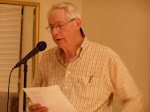
Two successful events brought over seventy-five people of all ages to Pine Hollow Arboretum on the weekend of April 29-May 1, 2011. The Music of Jim Williams and the written talent of the Delmar Writers Group brought out a nice appreciative crowd for the Showcase on Friday night April 29th. John Abbuhl said he parked seventeen cars which means there were more cars then deer at the Arboretum that evening. Marion Menna, Alan Casline, Paul Amidon, Jean Van Dyk, Mimi Moriarty read poetry. Susan Morse and Julie Cushine-Rigg shared some of their prose. It might be close but it appears there were more writers then ducks at the Arboretum.


Jim Willams makes music

poetry crowd at Pine Hollow Arboretum


Susan Morse


Poet Paul Amidon


Mimi Moriarty reads at Pine Hollow Arboretum

Sunday, May 1st was a sunny warm day and many people came by to visit the grounds during our Open House. For some it was a return visit but many had promised themselves in the past they would visit and were happy they had finally made the trek. The familar "I had no idea this was here" echoed in the hollow and up the hills. All were encouraged to come back and see the changing variety of flowering trees as we move into late Spring. It was nice seeing so many folks enjoy the plantings, ponds and trails. I must report, however, despite the large turnout that the frogs still outnumbered people by a large number. Here are some photos of the Open House.


--Alan Casline


Tuesday, April 26, 2011

SPRING APRIL 26, 2011

The Delmar Writers Group Reading is at 7:00 pm on Friday April 29, 2011
Grounds Open All Day. Visitors Center open staring at 5:30 pm.

OPEN HOUSE on Sunday May 1, 2001 starting at 2:00 pm. Arboretum Tour led by John Abbuhl Meet at Visitors Center


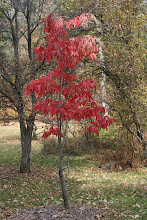
Photos taken on Tuesday April 26, 2011 by Alan Casline


Sunday, March 20, 2011

2011 SPRING EVENTS AT PINE HOLLOW ARBOURETUM


The weekend of Friday April 29th to Sunday May 1st are is going to be busy at Pine Hollow Arboretum. On Friday evening the Delmar Writers Group will presenting a Delmar Writers Showcase starting at 7:00 PM at the Visitors Center. Sunday Afternoon May 1st will be the Neighborhood and Community OPEN HOUSE.


Hello Neighbors!
We are the Pine Hollow Arboretum
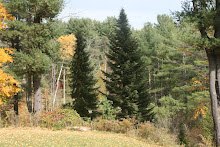
and we would love to show you around!

OPEN HOUSE

SUNDAY, MAY 1st, 2011
from 2 to 5 pm

at the Pine Hollow Arboretum
16 Maple Avenue
Slingerlands, New York 12195
(518) 439-6472

Pine Hollow Arboretum * a new not-for-profit * 25 acres of trees in a natural setting * within walking distance *


Bring your walking shoes or boots to hike the many trails and to see the property’s varied land and plantings. We go forth rain or shine! Interpreters will be available at unique places.

Light Refreshments will be offered!


No reservation needed but if you know you are coming
please e-mail us at pinehollowarb@aol.com and let us know.

Can’t make it. Send us your e-mail address if you want to stay
informed about opportunities and events

Wednesday, February 9, 2011

PHOTO OF VOLUNTEERS

This photo from the summer of 2010 by Mike Klugman shows many of our Pine Hollow Arboretum volunteers. These and other helpers, including Board Members, are a great resource and contribute to the effort needed to keep our place presentable.


Pictured (L to R): Ellen Manning, Audrey Hawkins, Kay Abbuhl, John Abbuhl, Sherry Hawley, Sue Dearstyne-Abbuhl, Marion Menna, Judy White, Donna Stiglmeier

Tuesday, December 14, 2010

DECEMBER VISIT


A snow storm sets up an opportunity to visit the Arboretum. There are lots of tracks when you get there. If you are lucky none of them will be human. Call ahead to (518) 439-6472 and John and Kate Abbuhl will make you welcome. I was dropping off the Pine Hollow Arboretum 2011 Calendar and brought my camera.


Tuesday, November 16, 2010

BALD CYPRESS


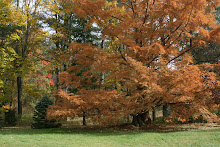
An example of the unique landscape at Pine Hollow Arboretum occurs late in the year when the view is filled with orange, rust and different brown colored trees as well as the different evergreens and yellow, brown and red deciduous hardwoods. One of the "rust" colors comes from the dozen or so Bald Cypress trees found in the Arboretum. The Bald Cypress or Swamp Cypress is a native American tree found in much of the southeastern United States from Maryland to Texas, especially inland up the Mississippi River to southern Indiana. It is common in the Everglades and is the official state tree of Louisiana. It is deciduous in the north and evergreen in the south. It has alternate, awl-shaped leaves, globose cones and sometimes aerial root knees.

The knees or upbent roots project from the root system upward above water level to facilitate gas exchange.Large trees reach 100-150 ft. tall with over 36 ft. trunk diameter. The Methuselah Cypress found in Big Tree Park in Longwood, Florida is 118 ft. tall and 3,500 years-old.

John Abbuhl points out they are a tree that will grow in standing water but they do not have to and will grow equally well in moist soil. John has found Bald Cypress can grow in the north provided the individual tree has the "right genetics". He doesn't think they have great variation in genetic make-up, as for example an apple tree has,but he has observed vast difference in growth pattern from individual tree to tree here in the Arborteum. He reported that there has been a 90% survival rate of Bald Cypress he has planted here. There is one area, however where it is different and 90% have not survived. He has observed it is where reed canary grass predominates. Bald Cypress are called "bald" because of their deciduous character. It is a member of the redwood family of trees. The true cypress belong to a separate family of trees. Like another decidous conifer found at Pine Hollow, the Metasequoia or "dawn redwood", the Bald Cypress dates from very ancient times. During the Jurasic Age it was a widely distributed tree. Two relatives of the Bald Cypress, the Weeping Bald Cypress and the Fastigate Bald Cypress are also present at Pine Hollow Arbouretum. The wood of the Bald Cypress was used by Seminoles for building their houses, canoes and for special ceremonial objects. The Choctaw Indians used the bark for string and rope. Making the wood useful is the fact it is extremely rot and termite resistant. In its native habitate it has been much used for roof shingles and traditionaly has a special use for greenhouse racks and benches. There is a current environmental concern over the use of cypress mulch as opposed to using cedar mulch. Damage to the ecosystem is being caused by the ravaging of cypress swamps in the south for mulch production. Cedar mulch seems more renewable and a more green choice

Sunday, November 14, 2010