Thursday, January 3, 2013
Why Evergreens are Green in Winter – Winter Photosynthesis
When
you look off the back patio at the arboretum during the winter months it’s such
a different scene then during the spring, summer or fall because most of the
leaves are off the trees. Not only can
you see farther down into the property from the same vantage point but what really
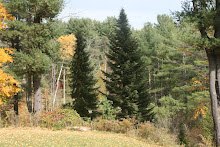
stands out to me are the highlights of green trees scattered throughout the
property. We all
know that when the seasons change and it starts to get cold and the days get
shorter deciduous trees automatically cut off connections to their leaves and
stop performing photosynthesis in order to save energy for the upcoming winter
months. But some plants and trees keep
their leaves all winter and they stay green.Trees
like evergreens and conifers continue to stay green all winter
because they have evolved special adaptions to survive the cold climate where
they grow.
First, these trees have
needles rather than leaves. The needles
are a way of protecting their foliage all year round. Snow easily falls off them. The shape of the needle and its waxy coating
is also designed to conserve water and minimize evaporation. These trees feed themselves all winter by
keeping chlorophyll in their needles by using smaller amounts of energy it
produces during the winter. The
chlorophyll is the chemical that makes photosynthesis possible and what causes
the needles to look green. Plants that
perform winter photosynthesis spend time during the spring and summer storing
energy. In simple terms, during the coldest
months, evergreens convert these starch cells back to simple sugars that can be
used to produce energy and food for the plant system, or to provide energy for
new growth in the spring.
Also, evergreens
are able to conduct photosynthesis in winter because the cells in the needles
are protected by a type of self-made antifreeze that is carried in the tree
sap. The cold temperatures and lack of
sunlight cause the photosynthesis process to occur more slowly and it is not as
efficient as warm weather photosynthesis which is why some needles end of
falling off the tree but many do not.
If you want to see
some winter photosynthesis in action visit the arboretum and see what nature
has to offer. The arboretum grounds are
open all year round. Happy New Year!
--- Sue Abbuhl
Thursday, December 6, 2012
CAMASSIA PLANTS AT PINE HOLLOW ARBORETUM
A purple flowering plant which grows on the shore of Greenhouse Pond and photographed by John Abbuhl is being featured in the 2013 Pine Hollow Arboretum Calendar. The plant is a Camas (Camassia) and it was cool to discover what an interesting plant the camas is. Our caption for under the photo was getting longer and longer until we decided we had to cut it down to a reasonable length. I figured a short write-up on this small species could share our discovered information with others. John Abbuhl said the camas was a native plant but not native to the shore of Greenhouse Pond where he had planted it. I found out that native was true if you are talking about the large expanse of North America where the camas naturally ranges. The perennial six-petaled plant is native to Southern British Columbia to Northern California and east to Montana. The plant existed in great numbers in meadows and could color the whole meadow in purple when they flowered. Later in history settlements reduced the prairies filled with camus because of grazing by cattle and hogs. There are still places in the Great Basin out West where they fill the landscape.
Camassia species were an important food staple for natives and even for early settlers in parts of the West. They were harvested in Autumn with the bulbs roasted or boiled. The experts say camas bulbs when cooked taste like a sweet potato but sweeter. I wonder if they have unexplored agricultural potential?.
The bulbs can be dried and pounded into flour. Folklorists have suggested the camas was also a important food source as a "cultivated plant" among the Tillamooks and other coastal peoples. These natives used burning to clear space for camas to grow out from under the forest cover. They were the second most popular trade good behind only dried salmon. Attention SCRABBLE players: the Kutchai called the camas "xapi". Common names for the plant are "Wild Hyacinth" and "Bear Grass".
There is no danger the camas are going to spread wildly and take over large sections of Pine Hollow Arboretum. John Abbuhl said that even though they were planted years ago there are only the original four camas plants growing in one small spot. The current year (2012) only two of them bloomed. Still it is worth the effort to find these out of their range but never-the-less interesting perennials. Deer do not like them which is an advantage around here.
----- Alan Casline
Wednesday, November 21, 2012
PINE HOLLOW ARBORETUM HOLIDAY CRAFT SALE
STOP BY THE VISITORS CENTER
Thursday, November 29, 2012 5-8 PM
16 Maple Ave, Slingerlands, NY
Hosted by Sandra Zwink, (518) 439-8105
Participating crafters include:
Kate Nare jewelry
Indigo fields handmade cards
Nancy Miller jewelry
Bake for You Happy
Happy Scraps (North Carolina)
Wednesday, November 14, 2012
AN INTERVIEW WITH DAWN REDWOOD
Interviewed by Bob Gordon
Hello, Dawn. May I call you Dawn?
That’s OK. Dawn Redwood is my common name. But, ironically, as people get to know me better, they call me by my proper name, Metasequoia. It’s short for Metasequoia glyptostroboides.
Since this is my first interview with you, I’ll call you Dawn. You and your family have moved around quite a lot. Where are you living these days?
My immediate family came to the US from China in 1946. They were seeds brought here by an expedition from the Arnold Arboretum in Boston, who then gave the seeds to arboreta around the country. My family has an interesting history. My ancestors’ fossils had been discovered in the early 1940’s and we were thought to be extinct. But then a couple of years later, a small stand of the trees was discovered in a remote Chinese valley. Despite the excitement, World War II prevented much from happening until our move to Boston in 1946. Then there was another lull in activity as US-China relations chilled. In the 1980’s, after relations between the two countries improved, new seeds were brought to the US. That finally allowed greater genetic diversity among the Metasequoias in the US, since that first group of us all came from just a single collection.
You didn’t answer my question. Does that mean you’re practicing for a career in politics?
No, I just got sidetracked. Sorry. What was the question, anyway? Although I’m about 50 years old, which is certainly not over the hill for my species, I still sometimes forget. Oh, now I remember the question; it was about where I live. My siblings and I live in the arboretum’s Metasequoia Field and Chinese Strip, just over the Japanese Hill. So I guess you could say I’m over the hill after all.
What about your extended family?
My distant cousins, the Coast Redwoods and Giant Sequoias, have lived in California since ancient times, where they grew big and became famous. Their publicity agent says they’re the biggest living things on the planet. I used to think that was just Hollywood hype, but it’s true. And besides, they’re in northern California, not Hollywood.
You sound jealous of your cousins.
No, not at all. I like living in upstate New York where I’m well cared for, with just the right climate and other growing conditions. As one of the 30 featured trees among the 3500 at the Pine Hollow Arboretum, I get all the attention I want.
Are your siblings both brothers and sisters?
Yes, … literally. Each mature Metasequoia contains both male and female cones, like most conifers. But I’m proud to belong to a select group of trees, the deciduous conifers. So like larches and just a couple of other trees, I have needles that turn color in the fall then drop off for the winter.
How many siblings do you live with? What are their names?
I have six siblings. They’re all named Dawn Redwood, too. By the way, there is no truth to the rumor that we Dawns gave Bob Newhart the idea for the brothers Larry, Darryl and Darryl.
You’re denying a rumor. Are you sure you’re not going into politics? If you’re all called Dawn Redwood, how do you identify yourselves?
We were all born in the late 1960’s and 70’s, so we distinguish ourselves by where and how we grow. I’m the widest, but my doctor, a tree surgeon, says I’m not overweight. Another Dawn is the tallest, since it’s able to grow very straight. Our colors are a little different, too. One of us has yellowish foliage; another one has light green foliage. Another sibling is distinguished by its dark trunk. Among the seven of us, the two tallest are more than 70 feet and still growing. Since Metasequoias are fast-growing trees, two others getting there quickly. The other three are still waiting for their adolescence.
Do you have marks on a closet door that show how much you’ve grown?
Don’t be silly. We outgrew closet doors years ago. My siblings and I started being measured two years ago when the American Conifer Society requested that our heights be monitored as part of a nationwide project to learn more about Metasequoias. People still don’t even know how big we can get or how long we can expect to live because there aren’t any old trees or family records in existence. That’s because many years ago the Chinese villagers used Metasequoias for lumber. Some people think we can live 400 or 500 years. Check back with me in a couple of hundred years and I’ll let you know if I’m having a mid-life crisis.
Do you have any children?
My siblings and I have all put down roots in Slingerlands and have decided to raise families here. The four oldest of us are already producing cones and we have produced seedlings.
You mentioned the ideal climate in upstate New York. Are you concerned about climate change?
Metasequoias are one of the few species that won’t be hurt by a little warming as long as we get the right amount of moisture. We can also tolerate temperatures that are much colder than what we get here. While a warming trend won’t affect me personally, I am still deeply concerned about the effects of climate change on other trees and on the whole planet. The edge of Hurricane Sandy didn’t damage any of us at the arboretum, but with more occurrences of extreme weather as the planet warms, I’m not sure we’ll continue to be so lucky.
I share your concern. I’ve enjoyed speaking with you and feel that I’ve gotten to know you better. Thank you, Metasequoia.
---Bob Gordon
Tuesday, October 30, 2012
HONEYLOCUST, BLACK LOCUST AND KENTUCKY COFFEETREE
THREE RELATIVES OF THE PEA FAMILY
Pine Hollow Arboretum Board member and accomplished area gardener Audrey Hawkins has contributed this article on her favorite tree, the Kentucky Coffeetree, and two of that tree's close relatives. All three species are included in Pine Hollow Arboretum's collection. Audrey says her favorite tree is the large Kentucky Coffee tree she has growing in her own yard.
Honeylocust (Gleditsia triacanthos), Black Locust (Robinia pseudoacacia) and Kentucky Coffeetree (Gymnocladus dioicus) are all in the Fabaceae Family
Bark of Kentucky Coffeetree
Bark of Black Locust
These three trees, native to the northeastern and mid-Atlantic United States have a lot in common but many ways to tell them apart. Being relatives of the pea family they all have seeds that are encased in a pod-like structure. The pods ripen and turn dark brown in October. Honeylocust has long narrow pods from 8 to 18 inches long and an inch wide that twist into irregular shapes. Kids like to use them as a rattle. The Kentucky Coffeetree has pods 5 to 10 inches long and 2 inches wide with a very leathery surface. Black Locust has a smooth flat pod that is 2 to 4 inches long.
All three trees have leaves that are either pinnately compound, bipinately compound or a mixture of both. All three have alternate leaf placement.(See below for illustrations of a compound leaf). The Honeylocust has both kinds of leaves. The bipinnate leaves on the Honeylocust are 6 to 8 inches long as are the pinnate leaves. The Kentucky Coffeetree has bipinnate leaves that are amazingly 36 inches long and 24 inches wide. The Black Locust has pinnate leaves that are 6 to 14 inches long. Both the Kentucky Coffeetree and the Black Locust have leaflets that are a deep shade of green with a blue tinge. The Honeylocust has much lighter hued green leaves that tend to drop off earlier in the fall season then the other two. All three have leaflets that are between 1 to 2 inches long and oval in shape. The Coffeetree has pointed leaflets.
Pinnately Compound Leaf from Kentucky Coffeetree (L) and Honeylocust(R)
One is most likely to see the Honeylocust tree because after the loss of many of our American Elm trees this tree was planted as a street tree. Many cultivars were developed which eliminated the prickles along the stem of the species and eliminated the pods. Unfortunately this tree has developed many diseases and insect problems that are exacerbated by planting many of the same kind of tree along an avenue instead of a diversity of species. The bark of a long established Honeylocust is rough and furrowed of a grey/brown color. The tree became especially popular with landscapers because it was easy to transplant and grew in many different kinds of situations. Also one can grow grass under this tree because it casts just a light shade.
Pinnately Compound Leaf from a Black Locust
The Black Locust is considered a weedy tree because it sprouts from the roots so you frequently see it growing in a grove. Because of this characteristic it is a good tree to plant on a slope that you are trying to stabilize or along highways and areas where tree cover would be an advantage. It’s not fussy about soil. Not good for a specimen tree on a lawn area for you will constantly be mowing down the sprouts. The bark of the mature tree forms long furrowed very deep ridges of a grayish color. It has prickles along the stems. There are numerous cultivars that have been developed mostly by European breeders that have mostly eliminated the prickles.
My real favorite is the Kentucky Coffeetree. The bipinnate leaves are so unusual being so large and the tree has a strange knobby look in the winter once the leaves have fallen. It has an interesting bark with scale like ridges but a beautiful pattern to the bark. It was once common in New York State and hopefully more will be planted for it has no diseases or insects of importance. It got its common name because when coffee was in short supply in Kentucky, the beans were roasted and made into a kind of coffee. It is said that the leaves and seeds are toxic to man and beast but roasting kills the toxins in the beans. There has been some progress made to develop cultivars. Also cloning only male trees so they do not have pods on them prevents a messy situation on a lawn. The species is a large tree, 75 feet at maturity so it would best be planted in parks or other large areas.
All three of these trees are hardy in Zone 4 to 8 since they are native to the Northeastern US.
---Audrey Hawkins
Pine Hollow Arboretum Board member and accomplished area gardener Audrey Hawkins has contributed this article on her favorite tree, the Kentucky Coffeetree, and two of that tree's close relatives. All three species are included in Pine Hollow Arboretum's collection. Audrey says her favorite tree is the large Kentucky Coffee tree she has growing in her own yard.
Honeylocust (Gleditsia triacanthos), Black Locust (Robinia pseudoacacia) and Kentucky Coffeetree (Gymnocladus dioicus) are all in the Fabaceae Family
Bark of Kentucky Coffeetree
Bark of Black Locust
These three trees, native to the northeastern and mid-Atlantic United States have a lot in common but many ways to tell them apart. Being relatives of the pea family they all have seeds that are encased in a pod-like structure. The pods ripen and turn dark brown in October. Honeylocust has long narrow pods from 8 to 18 inches long and an inch wide that twist into irregular shapes. Kids like to use them as a rattle. The Kentucky Coffeetree has pods 5 to 10 inches long and 2 inches wide with a very leathery surface. Black Locust has a smooth flat pod that is 2 to 4 inches long.
All three trees have leaves that are either pinnately compound, bipinately compound or a mixture of both. All three have alternate leaf placement.(See below for illustrations of a compound leaf). The Honeylocust has both kinds of leaves. The bipinnate leaves on the Honeylocust are 6 to 8 inches long as are the pinnate leaves. The Kentucky Coffeetree has bipinnate leaves that are amazingly 36 inches long and 24 inches wide. The Black Locust has pinnate leaves that are 6 to 14 inches long. Both the Kentucky Coffeetree and the Black Locust have leaflets that are a deep shade of green with a blue tinge. The Honeylocust has much lighter hued green leaves that tend to drop off earlier in the fall season then the other two. All three have leaflets that are between 1 to 2 inches long and oval in shape. The Coffeetree has pointed leaflets.
Pinnately Compound Leaf from Kentucky Coffeetree (L) and Honeylocust(R)
One is most likely to see the Honeylocust tree because after the loss of many of our American Elm trees this tree was planted as a street tree. Many cultivars were developed which eliminated the prickles along the stem of the species and eliminated the pods. Unfortunately this tree has developed many diseases and insect problems that are exacerbated by planting many of the same kind of tree along an avenue instead of a diversity of species. The bark of a long established Honeylocust is rough and furrowed of a grey/brown color. The tree became especially popular with landscapers because it was easy to transplant and grew in many different kinds of situations. Also one can grow grass under this tree because it casts just a light shade.
Pinnately Compound Leaf from a Black Locust
The Black Locust is considered a weedy tree because it sprouts from the roots so you frequently see it growing in a grove. Because of this characteristic it is a good tree to plant on a slope that you are trying to stabilize or along highways and areas where tree cover would be an advantage. It’s not fussy about soil. Not good for a specimen tree on a lawn area for you will constantly be mowing down the sprouts. The bark of the mature tree forms long furrowed very deep ridges of a grayish color. It has prickles along the stems. There are numerous cultivars that have been developed mostly by European breeders that have mostly eliminated the prickles.
My real favorite is the Kentucky Coffeetree. The bipinnate leaves are so unusual being so large and the tree has a strange knobby look in the winter once the leaves have fallen. It has an interesting bark with scale like ridges but a beautiful pattern to the bark. It was once common in New York State and hopefully more will be planted for it has no diseases or insects of importance. It got its common name because when coffee was in short supply in Kentucky, the beans were roasted and made into a kind of coffee. It is said that the leaves and seeds are toxic to man and beast but roasting kills the toxins in the beans. There has been some progress made to develop cultivars. Also cloning only male trees so they do not have pods on them prevents a messy situation on a lawn. The species is a large tree, 75 feet at maturity so it would best be planted in parks or other large areas.
All three of these trees are hardy in Zone 4 to 8 since they are native to the Northeastern US.
---Audrey Hawkins
Tuesday, October 2, 2012
INVITATION TO OUR FALL FESTIVAL
Fall Festival at Pine Hollow Arboretum
Please join us for a celebration of Fall!
Sunday, October 28, 2012
1:00 p.m. to 4:00 p.m.
At the Visitor's Center
(16 Maple Avenue, Slingerlands)
Activities Include:
Aborteum Tour led by John Abbuhl starting at 2:00 p.m.
Pumpkin Scavenger Hunt
Pumpkin Carving
Collage Making
Letterboxing for Families
30 Significant Trees Self-Tour
Final viewing of Art Show featuring 30 local artists.
Come and enjoy the season!
Sunday, October 28, 2012
1:00 p.m. to 4:00 p.m.
At the Visitor's Center
(16 Maple Avenue, Slingerlands)
Activities Include:
Aborteum Tour led by John Abbuhl starting at 2:00 p.m.
Pumpkin Scavenger Hunt
Pumpkin Carving
Collage Making
Letterboxing for Families
30 Significant Trees Self-Tour
Final viewing of Art Show featuring 30 local artists.
Come and enjoy the season!
Saturday, September 15, 2012
ART SHOW AND SALE
Now that summer activites are winding down, we are pleased to welcome 30 local artists for a SHOW AND SALE to CELEBRATE NATURE! The Opening Reception will be on Sunday Sept 23rd from 1-4 PM at the Visitors Center at 16 Maple Ave.Slingerlands, NY. The art works will remain at the Center though the month of October and all are invited to come during the usual "open hours" of 10 - 4 on Saturdays and Sundays. I will try for some pictures soon... Come and enjoy the art work and the property in this beautiful and "cooler" season .
Subscribe to:
Posts (Atom)